
IN-F015 minIndex Reading Under Open Question Headings
Independent study · 20 cards
Habits studied from Isaac Newton.
Natural philosopher, mathematician, and Keeper/Master of the Mint. These 20 cards distill his Trinity College notebook discipline, apparatus-first verification, and single-problem immersion — bounded for healthy modern days.
- Foundation 8
- Growth 6
- Mastery 4
- Challenge 2
What was studied
How we read the record.
Cambridge notebook Add. MS 3996 (Quaestiones quaedam philosophicae, 1661–1665), experimental papers on optics, and eyewitness accounts collected by John Conduitt underpin 20 cards. Newton’s edge came from indexing open questions tightly and keeping one problem constantly before the mind until clear.
Notebook Workspace
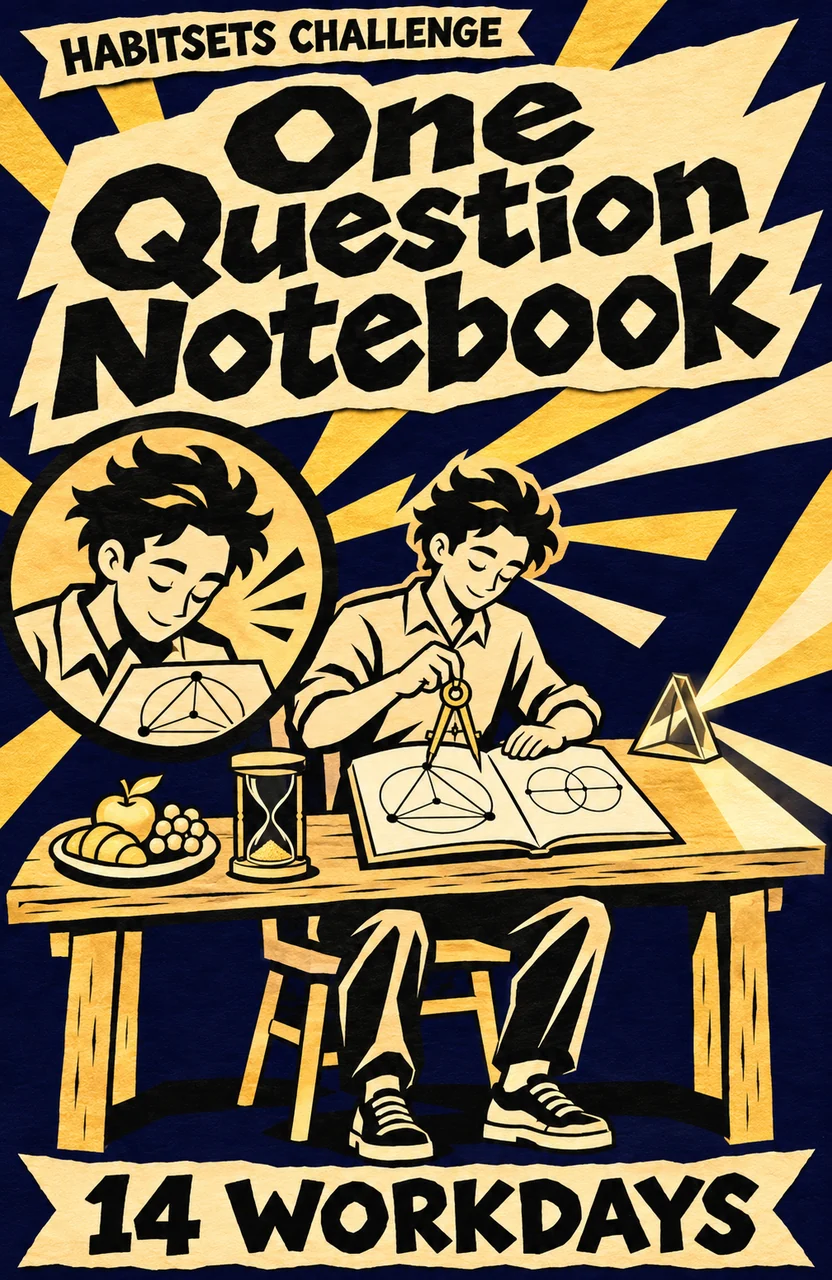
Organized reading by thematic question headings (Quaestiones), jamming dense marginalia and cross-references rather than copying lectures linearly.
Apparatus Before Opinion
Opened Quaestiones with 'truth is a greater friend' than Plato or Aristotle, buying prisms at fairs to measure actual beam geometry himself.
Sustained Immersion
Held one stubborn question continuously in view between drafts rather than scattering attention across twenty shallow topics at once.
Nuances preserved
- Topic-headed inquiry notebooks over chronological notes
- "Truth is a greater friend" audit against prestige sources
- Re-derive proofs from scratch rather than skimming solutions
- Keep one stubborn question active across quiet walks
- Separate messy waste-book math from fair copy proofs
- Strict modern meal & sleep cutoffs replace historical neglect
Contemporary accounts (Conduitt, Humphrey Wickins) note Newton frequently skipped meals and lost sleep during bursts of obsessive work. Those 16–18 hour marathons are excluded as unsafe: these cards translate his single-problem depth into bounded 60–90 minute blocks with explicit rest stops.
The cards
Their methods, for today.
20 cards · tap a card to flip it
Foundation 8
The load-bearing practices you return to. Build the base and keep it in play.
Growth 6
Supporting habits that improve the conditions for useful repetitions: preparation, consistency or necessary recovery.
Mastery 4
Inspect your work, apply a specific correction in later practice and check whether it helped.
Challenge 2
A bounded mission with an observable finish, supported by the practices you use.
Research sources · 6
Isaac Newton, Quaestiones quaedam philosophicae (c.1661–1665), Cambridge University Library, Add. MS 3996. Read the source ↗
Isaac Newton to Robert Hooke, 5 February 1675/6, The Correspondence of Isaac Newton, vol. 1, Cambridge University Press (1959).
Isaac Newton, A New Theory about Light and Colors, Philosophical Transactions of the Royal Society, No. 80 (19 February 1671/2).
Isaac Newton, Opticks: or, A Treatise of the Reflections, Refractions, Inflections and Colours of Light, 4th ed. (London, 1730).
John Conduitt, Biographical memoranda on Sir Isaac Newton (King’s College Library, Cambridge, Keynote/Portsmouth papers, c.1727–1732).
Richard S. Westfall, Never at Rest: A Biography of Isaac Newton, Cambridge University Press (1980).
From the screen to the fridge
Keep your practice in sight.
Library cards are free to read and print. Choose the ones you’ll use, put them where their cues happen, and keep returning to the practice. Our boxed collections are separate printed editions.