




Free · £0
Sheet 1
Yours, now. One habit, four weeks.
At month's end, scan it for your next sheet.
Change the moment above or your level here, and this sheet follows. Every Get It Written card, every level and every Challenge, to print.
Thirty openings in a folder, and a file called ending_v2. You reread three first paragraphs, fix a comma, and shut the laptop.
The next sentence, past the opening. Count the words on a free sheet.

her story
Sunday night, the kitchen table. Thirty openings in a folder, and a file called ending_v2.

A writing course, to week four. Morning pages, for nine days. A streak app. None of it got past a first page.

Three printed pages: three versions of the same first paragraph. Then it clicks: not a course. Write the next bit, on a ride she already takes.

The bus home. She turns past the opening of the piece about her mum's good scissors and writes until her stop. 140 words. Not good. Counted.
Your 1s
Finishing a piece sounds like a talent some people have. In practice it breaks into three counts: new words past where it stopped, passes that change a draft for a reason, and pieces called done. Start with the next sentence, today. Nobody can promise it's good. You can count what you wrote.
150 words a go×1 go a workday
= 39,000 words a year
750 a week × 52 weeks. Arithmetic on your own week, not a promise.
The ways
Each card is one way to do a 1. Levels go easy to harder; pick the one that fits the day. Tap one to see how it goes.
Start here
One card. One row. Four weeks. Write what you did in the day's box.
Sheet 1 · weeks 1–4
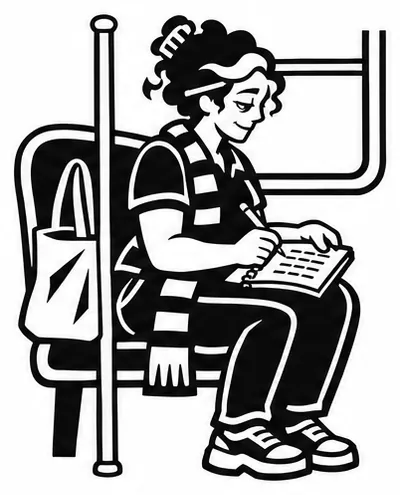
Find the last line and write the next sentence, then the one after, until your stop.
Write on · tap a day
Write what you did in the day's box: 10 here, 20 there, the day's total when you're done. Blank day? It takes nothing off. The total carries to Sheet 2.
A4 · any pen · no sign-up ·
On a bus or train, as a passenger only: never while driving, cycling or walking. Your stop in mind.
her story

One row: Write on, the bus home. Folded into the back of the notebook. Forced at first: the box is empty, so the notebook comes out.

The bus is packed both nights. She stands. The boxes stay blank. Nothing comes off the sheet.
Sit down, notebook out, last line, next sentence. She counts the new words and writes the number in the day's box: 140, 160, 150.
WoWrite on new///3sit down, last line, next sentence.
Triggers
A trigger is something your day already does. Once your first 1 feels doable, hang it on one: the moment does the remembering.
WoHabit cardWrite on · 1 word
Let Sheet 1 hold first. Then hang the same 1 on two or three moments, and add a row for another 1. Tap a day to mark it.
Write onI sit down on the bus home
scissors piece. 140. not good. counted.
Write on2 triggers · 2 = two 1s that day
Read it outWhen the kettle's on
lunch, tue and thu. started the ladder piece.
Write on3 triggers · 2–3 = multi-go days
Read it outHolding steady
Call it doneThird habit joins
bus in, tue and thu. ladder piece, the row with the neighbour.
her story

Laptop shut, notebook on the lid: Tuesdays and Thursdays the scissors piece gets a second go.

While it boils she reads a page out loud and fixes the first place she trips. A new row: Passes.

Thursday at bedtime, a rough ending. Sunday she reads the scissors piece first line to last, titles it, dates it. A new row: Pieces.
WoWrite on/////5RoRead it out new///3CdCall it done new/1none of it takes deciding now.
Compounding
Keep one go steady on Sheet 1, then hang more words on the lunch break and the bus in. All three moments add words, nothing else.
Sheet 1 · Weeks 1–4
→1past the opening, until her stop
Write on · tap a day to mark it
An estimate on her sheet: 5 a week on Sheet 1, adding up to 5 + 2 + 2 a week across 52 weeks, leaving one in seven blank.
Levels
Once a row holds without effort, circle Level 2. Same 1, stepped up inside the cards.
Her Write on row stays in the same place on every sheet — only the circled level moves up.
LV 1Sheets 1–3 · Workdays
Write onwords written in
LV 2Sheets 4–6 · Workdays
Write onwords written in
LV 3Sheet 7 · Workdays
Write onwords written in
More cards · Level packs
Every Foundation card steps up inside its own row. Tap any pack to read its levels side by side.
Move up when one feels ordinary. Rough week? Drop back a level — it's still a 1.
her story
The next sentence went ordinary, so she's on Level 2: the spare-key piece, carried through to what it caused. Same bus rides.

Four days off in week two. Four blank boxes. Nothing lost. Monday she gets back on the bus and finds the last line.
Level 3: she writes the passage she'd stepped round for weeks, why her dad sold the van. Still one bus ride.
WoWrite on · Lv 3/////5RoRead it out///3CdCall it done/1a bad week? level 1 still counts.
The offer
Your first sheet is free. One payment covers every sheet after it, and every set.
Free · £0
Yours, now. One habit, four weeks.
At month's end, scan it for your next sheet.
Change the moment above or your level here, and this sheet follows. Every Get It Written card, every level and every Challenge, to print.
The System
Four habits on one sheet, one from Leave Work at Work. Every number carried, every pile added up.
I built this for myself, to fight off the never-ending sales pitches online. It has one job: making results simple. So this is my one pitch, and it's short.
This is how we grind.
No streak to break. No bad month that wipes the good ones. Every sheet starts where the last one stopped. Small 1s, written down, carried.
Not on sale yet.
One payment. Every set. No subscription.
Challenges
Once your 1s run themselves, pick a bounded Challenge with a name, an end and an honest way out.
her story
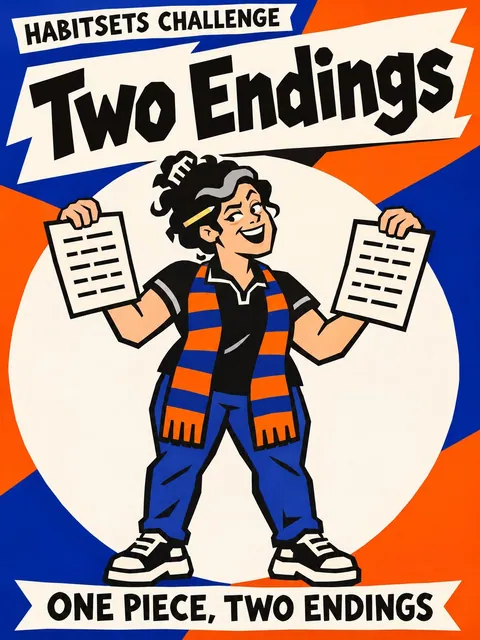
Sheet 5. Three pieces on the stack, and every one ends with her explaining the lesson. She picks Two Endings for the spare-key piece.

“Two endings for the spare-key piece. One explains, one doesn't. The loser goes in Buried on Sunday. Don't let me chicken out.”
Month six, she keeps the one where her mum just hands the key back. The other goes in Buried. Monday it's the bus again.
WoWrite on · Lv 2/////5RoRead it out///3CdCall it done/1ChallengeTwo EndingsStill just 1s.
Bonus · Extras
Optional side habits with their own count — never on Sheet 1, never added to your 1s. Tap any item to inspect.
Each keeps its own count, never added to your words, passes or pieces, and no levels. · One at a time, and never on the free sheet: your first sheet is your 1s.
Sheet 1 is free: one card, four weeks, any pen. The System, when it's ready, keeps every sheet after it going, with the levels, the Challenges and the Extras.
Writing about someone real? Change what they'd be known by or ask them first, and never put invented words in a real person's mouth as fact. A draft never has to be shown. On the bus, write as a passenger only. Copies stay credited in your notebook. This set never measures or promises quality, readers, publication or a finish date.


 Write on